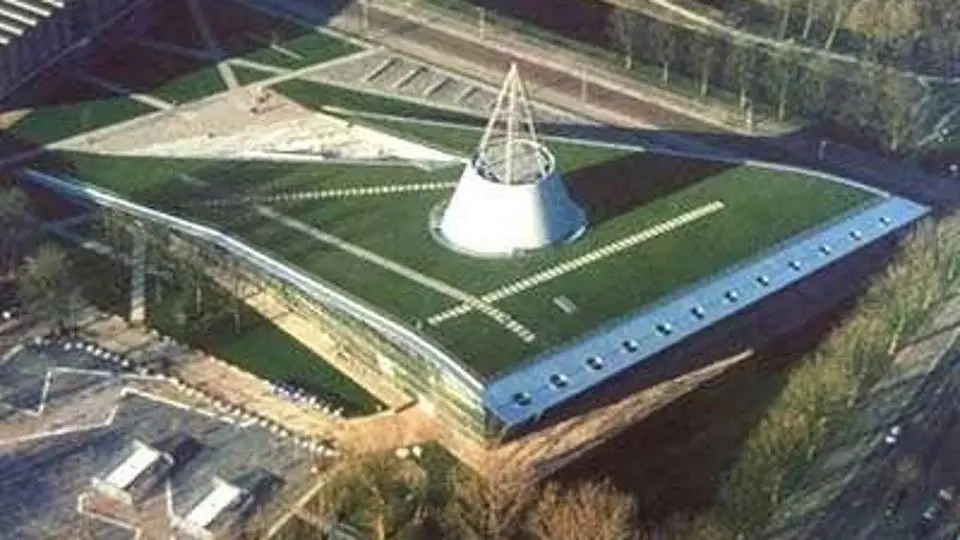
Delft University of Technology is the largest technical university in the Netherlands and internationally leading in scientific research. The Petroleum Engineering section resides within the Department of Geoscience and Engineering, one of six departments within the Faculty of Civil Engineering and Geosciences. The department stands for top-level research and education aimed at finding answers to tomorrow's questions on the use of the earth's natural resources and its subsurface space.
The Petroleum Engineering section has an international faculty and student body and excellent laboratory facilities. Research is supported by a variety of industrial and government programmes. Ongoing strengths of the programme include research in optimal control and data assimilation, complex fluids, enhanced oil recovery, petrophysics, and flow through porous media. A key component of our research is close cooperation with other disciplines in the geosciences, engineering and mathematics.
Job description
The PhD candidate will work on a project carried out at Petroleum Engineering and in close collaboration with the Department of Applied Mathematics and the Shell Exploration & Production International Centre in Rijswijk.
Many enhanced oil recovery (EOR) processes can be described using partial differential equations with parameters (e.g. reaction constant, foam strength) that are strongly nonlinear functions of one or more of the state variables (e.g. saturations, temperature). Typically these non-linearities result in solution components changing several orders of magnitude over small spatial or temporal distances.
The numerical simulation of such processes with the aid of finite volume or finite element techniques poses challenges. In particular, strongly temporally oscillating state variable values were observed for realistic grid sizes when conventional discretisation schemes were used. These oscillations, which do not represent a physical process but are discretisation artefacts, strongly hampered the use of the forward simulation model for optimisation purposes. In particular, the application of gradient-based production optimisation methods using an adjoint method proved to be troublesome.